

Quick answer
Most Klaviyo agency engagements are priced according to the amount of strategy, creative production, automation, deliverability work, and ongoing optimization required. A small project may be priced as a one-time setup, while a complete email and SMS program is usually managed on a monthly basis.
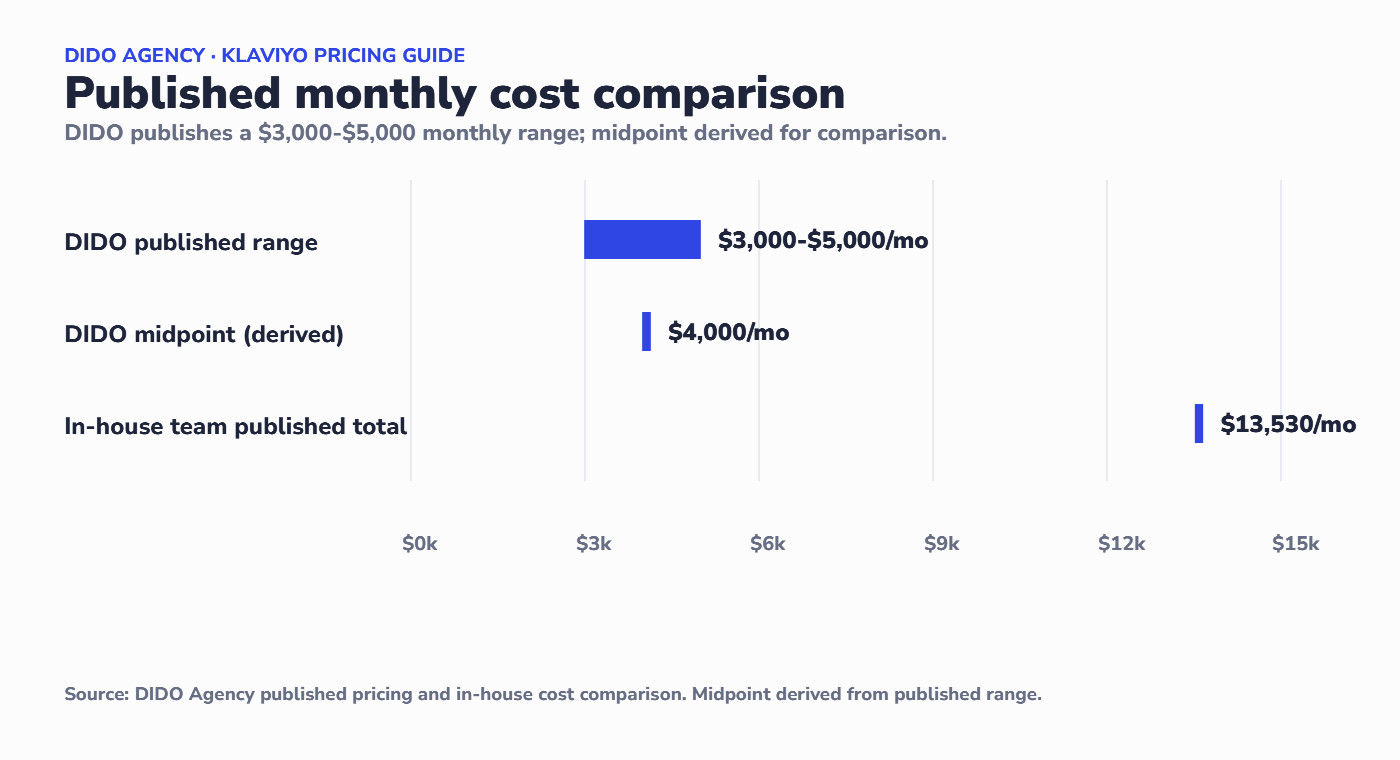
DIDO Agency publicly lists monthly packages in the $3,000–$5,000 range. The final price depends on your store, list size, number of flows, campaign frequency, integrations, creative requirements, and the level of reporting and optimization your team needs. A reliable quote should follow an account review—not be based on revenue alone.
What does a Klaviyo agency actually do?
Klaviyo is a powerful platform, but the software does not create the strategy by itself. An agency may be responsible for some or all of the following:
- Auditing your existing account and identifying missed revenue opportunities.
- Planning and building automated flows.
- Writing email and SMS copy.
- Designing reusable email templates and campaign creative.
- Creating segments based on customer behavior and purchase history.
- Managing campaigns and promotional calendars.
- Testing subject lines, offers, layouts, timing, and audiences.
- Improving deliverability and list quality.
- Connecting Klaviyo with Shopify, WooCommerce, BigCommerce, Magento, reviews, loyalty, subscription, and customer-service tools.
- Reporting on revenue, engagement, retention, and customer lifetime value.
That is why the price of an agency is not equivalent to the price of a Klaviyo subscription. The platform is the technology. The agency provides the people, judgment, creative work, implementation, and ongoing decisions that turn the technology into a revenue channel.
The main Klaviyo agency pricing models
1. One-time project pricing
A one-time project is appropriate when you need a defined deliverable, such as:
- A Klaviyo account audit.
- A migration from Mailchimp or another email platform.
- A welcome flow and abandoned-cart flow.
- A new email design system.
- An SMS compliance and setup project.
- A deliverability repair or list-cleaning project.
This model is easier to budget because the scope is fixed. It can be a good starting point for a growing brand that needs its foundation built before committing to ongoing management.
The risk is that a one-time project can leave the program without an owner after launch. Flows need monitoring, campaigns need to be coordinated with inventory and promotions, and customer behavior changes over time. If no one is responsible for optimization, the initial build may gradually lose effectiveness.
2. Monthly retainer
A monthly retainer is designed for brands that want an ongoing partner. Depending on the plan, the agency may manage strategy, campaigns, flows, design, copywriting, SMS, testing, analytics, and deliverability.
Monthly pricing usually rises when the agency is responsible for more production and more channels. A brand sending four campaigns per month has a different workload from a brand sending twenty campaigns, running multiple regional calendars, and coordinating email with SMS.
The most important question is not “What is the monthly fee?” It is “What is included every month?” Ask for the expected number of campaigns, flow work, strategy meetings, reports, revisions, tests, and support hours.
3. Performance-based pricing
Some agencies offer a lower base fee combined with a percentage of attributed revenue. This can align incentives, but it requires a clear definition of attribution. Klaviyo-attributed revenue is not always the same as incremental revenue generated by the agency. A customer may have purchased anyway, interacted with several channels, or been counted by multiple systems.
Before agreeing to performance pricing, define:
- Which revenue events count.
- Which attribution window is used.
- How refunds and cancellations are treated.
- How existing automated revenue is separated from new work.
- Whether SMS and email are measured together or separately.
- What happens when tracking, consent, or platform integrations change.
4. In-house team plus specialist support
Some brands keep a marketing manager in-house and hire an agency for design, copywriting, automation, deliverability, or strategic support. This can work well when the brand has strong internal ownership but needs specialized capacity.
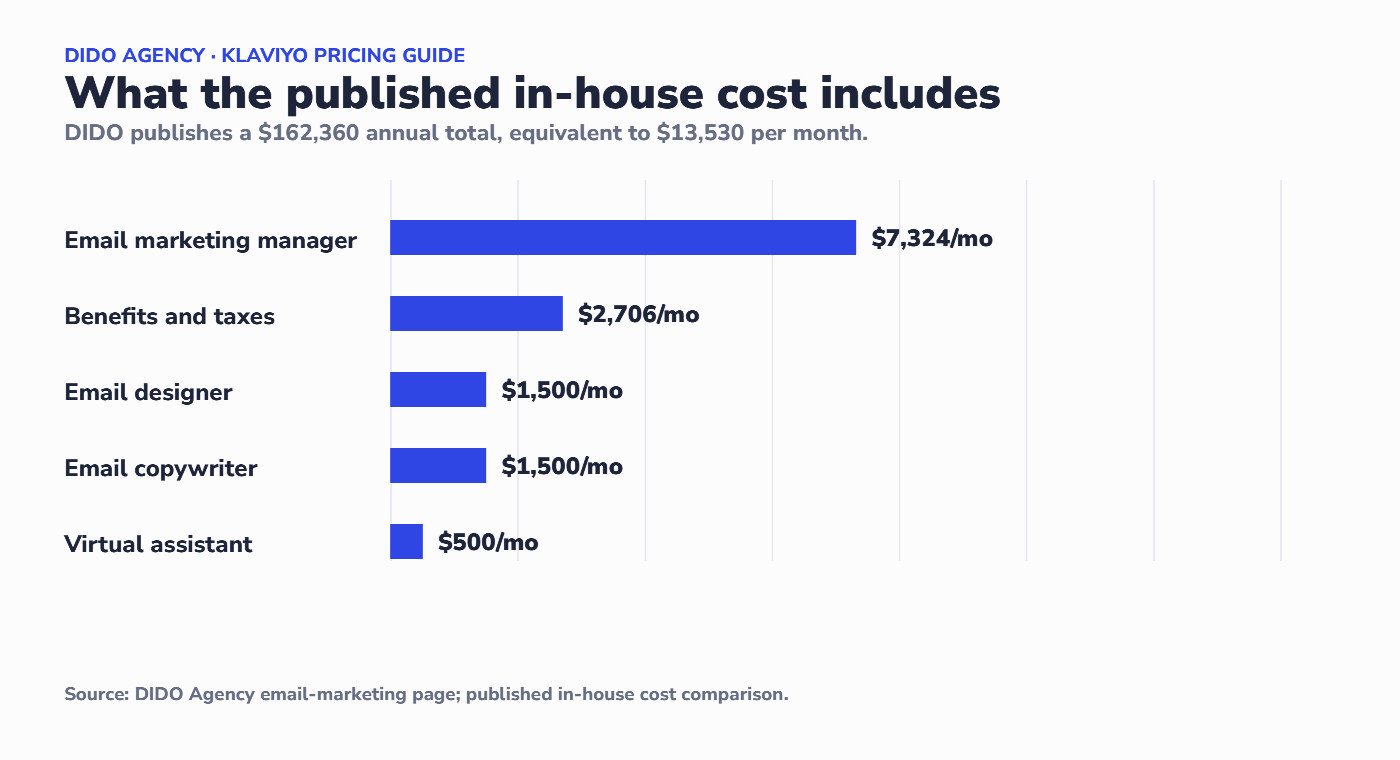
It may also be more expensive than expected if the brand is paying for several separate specialists. The real comparison should include salary, benefits, recruiting, management time, software, freelance support, and the cost of delayed campaigns.
| Working model | Best fit | Clarify before signing |
|---|---|---|
| One-time project | A defined audit, migration, or flow build | Who owns optimization after launch |
| Monthly retainer | Ongoing campaigns, flows, testing, and reporting | Campaign volume, revisions, and what each month includes |
| In-house team plus specialist support | A brand with a capable internal owner that needs extra expertise | Who is responsible when creative, data, and delivery overlap |
What determines the cost of Klaviyo management?
Store revenue and business stage
Revenue is useful context, but it should not be the only pricing variable. A smaller store with a complex catalog, multiple regions, and frequent launches may require more work than a larger store with a simple product line.
The key question is how sophisticated the program needs to be. A new store may need a clean foundation and a few essential flows. A mature brand may need advanced segmentation, predictive analytics, replenishment journeys, VIP programs, subscription retention, and detailed cohort reporting.
Number of flows
Most ecommerce brands should consider more than welcome and abandoned cart. Depending on the customer journey, the program may include browse abandonment, post-purchase education, cross-sell, replenishment, review requests, back-in-stock alerts, price-drop alerts, win-back, VIP, birthday, and sunset flows.
Each flow requires more than a trigger. It needs audience logic, message strategy, creative, copy, timing, exclusions, testing, and quality assurance.
Campaign volume
Campaign management includes planning, writing, design, building, testing, scheduling, and reporting. A higher send frequency creates more production work, especially when the brand has different audiences, product categories, or promotional calendars.
More campaigns are not automatically better. The right volume depends on list engagement, inventory, margin, customer expectations, and the quality of the content. A good agency should be able to explain why a campaign is being sent—not simply fill a quota.
Email, SMS, and additional channels
Email and SMS can share customer data and segmentation, but they should not always send the same message at the same time. Adding SMS creates additional work around consent, compliance, message timing, segmentation, and two-way customer expectations.
Brands may also request support for RCS, WhatsApp, direct mail, lead generation, or customer-service integrations. Every additional channel should have a clear role in the lifecycle strategy.
Design and copywriting requirements
A brand with an established design system may need fewer creative hours than a brand starting from scratch. Custom illustration, product photography, animation, multiple language versions, and frequent revisions all affect the workload.
The best creative process is not just about making emails look attractive. It connects design and copy to the product’s value proposition, customer objections, offer economics, and the stage of the customer journey.
Data, integrations, and deliverability
An account with incomplete events, duplicate profiles, broken integrations, poor consent records, or deliverability problems needs more diagnostic work. Integrations with Shopify, WooCommerce, reviews, loyalty, subscriptions, help desks, and advertising platforms can increase the value of Klaviyo—but also increase the need for technical quality assurance.
What should be included in a monthly Klaviyo agency package?
Before signing, request a written scope that answers these questions:
- How many campaigns are included each month?
- Are strategy, copy, design, building, and scheduling all included?
- How many flows will be built or optimized?
- Is SMS included, and how are consent and compliance handled?
- Are integrations and tracking reviewed?
- How many revisions are included?
- How often will the agency test and optimize?
- What reporting will be delivered?
- Who owns the account, creative files, and automations?
- Is the agreement month-to-month or contract-based?
A low monthly price may exclude the work you assumed was included. A higher price may be justified if it includes a complete team across strategy, copy, design, automation, and deliverability. Compare scope and expected business outcomes, not just the headline number.
DIDO Agency’s approach and pricing
DIDO Agency publicly lists monthly packages between $3,000 and $5,000. The agency describes its work as a done-for-you ecommerce email and SMS service covering strategy, campaigns, flows, segmentation, design, copywriting, testing, and optimization.
DIDO also states that pricing is adjusted after reviewing the Klaviyo account, website, and project requirements. That approach is important because two stores with the same revenue can require very different levels of work.
DIDO’s published experience includes work across Shopify, WooCommerce, BigCommerce, and Magento, as well as ecommerce categories such as beauty, fashion, jewelry, health, food and beverage, and pets. The website also presents client examples and performance results. Any case-study number should be read together with its timeframe, attribution method, starting point, and the work that was performed.
How to calculate whether an agency is worth the investment
Do not evaluate the agency only by looking at the percentage of revenue attributed to email. Instead, build a simple business case using:
- Current email and SMS revenue.
- Contribution margin, not just gross sales.
- Repeat-purchase rate.
- Customer lifetime value.
- List growth and engaged-profile growth.
- Deliverability and inbox placement.
- Revenue from flows versus campaigns.
- Revenue from existing customers versus newly acquired customers.
- The internal time required to manage the program.
For example, if an agency costs $4,000 per month, the required incremental contribution is different for a brand with 70% gross margin than for a brand with 30% gross margin. The calculation should also account for retained customers and the value of work that the internal team no longer has to perform.
When should an ecommerce brand hire a Klaviyo agency?
Hiring an agency is worth considering when:
- Your team is sending campaigns but not improving the underlying program.
- Flows are incomplete, outdated, or difficult to maintain.
- Email revenue is flat despite list growth.
- Your team lacks design, copy, automation, or deliverability expertise.
- You are preparing for a major product launch or seasonal event.
- You are migrating from another platform.
- Your marketing manager is spending too much time producing emails instead of planning growth.
- You want a partner accountable for both execution and improvement.
You may not need a full-service agency if your store is brand new, your list is very small, or you have an experienced internal lifecycle marketer with enough creative and technical support. In that situation, an audit or a focused flow project may be the better first step.
What should you ask on a Klaviyo agency sales call?
Ask who will do the work. A sales conversation can sound complete while the delivery plan is vague. You need to know whether the account will have a strategist, designer, copywriter, automation specialist, and deliverability support, or whether one person is covering every role.
Then ask to see the first 90 days in plain language. The answer should name the audit work, priority flows, campaign rhythm, measurement plan, and the inputs DIDO needs from your team. If the agency cannot explain the first phase without promising a result before it has reviewed the account, the scope is not ready to price.
Finally, make the reporting conversation specific. Ask which decisions the report will support, how campaign and flow performance will be separated, and who will be responsible for acting on the findings. A monthly deck is not useful if no one can say what changes because of it. Ask to see an example of the decision log or testing backlog, with customer names and commercially sensitive figures removed. It shows whether reporting turns into better sends and stronger flows, or simply becomes a recurring meeting. The right partner should be comfortable answering these questions before you commit.
- Who will be responsible for strategy, creative, automation, and deliverability?
- What will be completed in the first 90 days, and what depends on our team?
- Which program decisions will the monthly report help us make?
- What work is outside the retainer and how is it approved?
Final answer: what should you budget?
For a serious ecommerce brand, budget according to the scope of the lifecycle program rather than the Klaviyo software bill. Expect one-time projects to be scoped separately from ongoing management, and expect a full-service monthly engagement to cost more when it includes strategy, copy, design, automation, SMS, deliverability, reporting, and continuous testing.
DIDO Agency’s publicly listed monthly range is $3,000–$5,000, with final pricing determined after reviewing the account and requirements. The next step should be an audit or discovery conversation that identifies the revenue opportunities, required workload, and realistic measurement plan.
Sources
- DIDO Agency partner program for the published monthly package range.
- DIDO Agency email marketing services for the published in-house comparison and service scope.
Frequently asked questions
Is hiring a Klaviyo agency worth it?
It can be worth it when the agency improves the complete customer lifecycle—not just the number of emails sent. Evaluate the program using incremental contribution, retention, deliverability, flow performance, and the internal cost of managing the work.
Does a Klaviyo agency include SMS marketing?
Some do and some do not. Confirm whether SMS strategy, copy, design, compliance, segmentation, and reporting are included in the proposal.
How long does it take to see results?
Foundational improvements can produce early gains, but reliable evaluation usually requires enough time to launch, test, and compare performance across flows and campaigns. The timeline depends on traffic, list size, seasonality, offer strength, and the condition of the existing account.
Can a Klaviyo agency work with Shopify or WooCommerce?
Yes. The agency should confirm that ecommerce events, product data, customer properties, consent records, and revenue tracking are passing correctly before relying on performance reporting.
Should I choose a freelancer or an agency?
A freelancer may be a good fit for a limited project or smaller program. An agency may be a better fit when you need multiple disciplines—strategy, copy, design, automation, deliverability, and analytics—working together.
Does DIDO Agency offer a free audit?
DIDO Agency promotes a free email or BFCM audit. Confirm the current scope, turnaround time, access requirements, and deliverables before requesting one.